Aug 2026
coding agents: what's next
The first wave made code generation dramatically faster. The next will make intent explicit and correctness observable.
The first wave made code generation dramatically faster. The next will make intent explicit and correctness observable.
The thesis: coding agents will not become dependable merely by writing more code. They need an upstream system that clarifies what to build and a downstream system that proves how the result behaves.
AI coding has fundamentally changed how software is written, and the improvements are real. Tools such as Claude Code and Cursor increase developer velocity and often encourage teams to rethink designs rather than merely type faster. But as AI writes more code, the bottleneck is moving. Correctness and resilience can no longer be left to conventional testing alone; testing and verification are becoming the scarce resources in the software-delivery system.
Ion Stoica's recent talk on the limits of AI coding agents provides a useful frame: https://www.youtube.com/watch?v=vuDurF3b_ds The ceiling on autonomy is defined by two gaps on either side of code generation: the gap between what people mean and what they specify, and the gap between code that looks right and behavior we can establish as correct.
1. The requirements gap: building the wrong thing faster
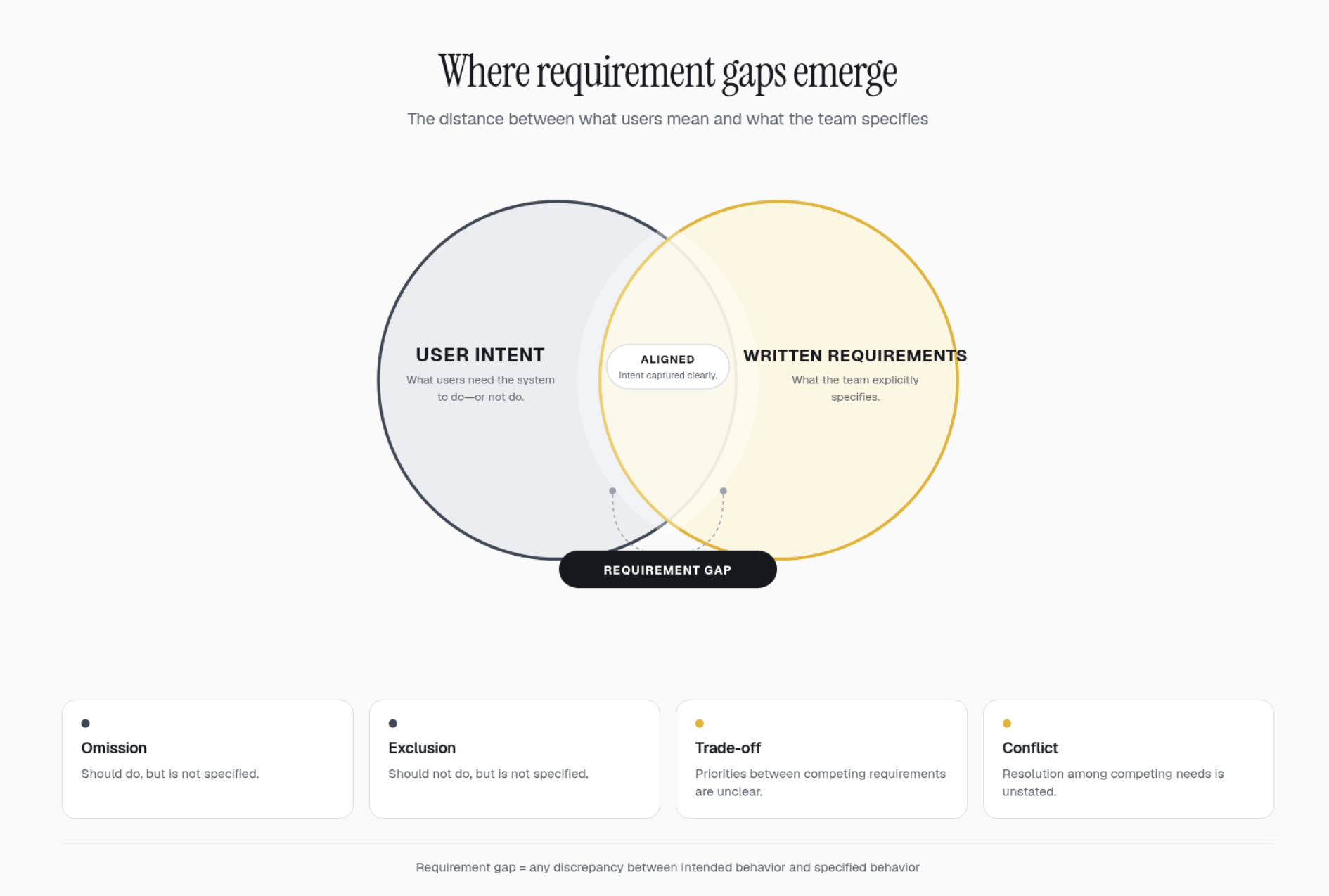
A requirements gap is any discrepancy between intended behavior and specified behavior. It appears as an omission (something the system should do but the spec never says), an exclusion (something it must not do but the spec leaves open), an unstated trade-off, or an unresolved conflict. Humans often bridge these gaps with customer history, architectural memory, and hallway context. A coding agent does not. It can produce a clean, internally consistent implementation of the wrong requirement—and do so at machine speed.
This is why Allstacks Product Studio (https://www.allstacks.com/product/product-studio ) belongs upstream of the coding agent. It grounds requirements in the actual codebase, customer voice, delivery history, and strategy documents; scores work for readiness; and uses adversarial reviewers to surface security, architecture, QA, feasibility, and go-to-market risks before implementation. The goal is not a longer PRD. It is a lower-entropy handoff: assumptions exposed, evidence attached, trade-offs made explicit, and a build-ready package that can flow into Cursor, Claude Code, Copilot, or another agent.
2. The verification gap: trusting what ships
Even a strong specification does not guarantee a correct implementation. The verification gap is the distance between an output that appears plausible—or passes the easiest checks—and one whose behavior can be established under the conditions that matter. This gap widens when the same class of model writes the code, writes the tests, and reviews the pull request: the loop is fast, but its blind spots can be correlated.
The empirical warning is already visible. A 2026 study of 302,600 verified AI-authored commits (https://arxiv.org/abs/2603.28592 ) found that more than 15% of commits from every coding assistant studied introduced at least one issue; 22.7% of the tracked issues were still present in the latest repository revision. Gradient Ventures' Coding Agents 2.0 (https://www.gradient.com/blog/posts/coding-agents-2/ ) reaches the same strategic conclusion: the first race—whether models can write code—is largely settled. The next races are orchestrating fleets, serving coding workloads economically, and verifying what those fleets produce.
The startup map is moving around the model
Gradient's map captures three layers forming around the model: fleet orchestration (Emdash, Superset, Conductor), coding-native inference (Synthetic, Crush/Hyper), and verification through AI review, formal methods, or trace comparison (Maida). Code generation is becoming the middle of a much larger system.
WireMock turns environments into a verifier
For most enterprise applications, a large share of correctness lives at system boundaries: APIs, data shapes, timeouts, rate limits, state transitions, authentication flows, and failure modes. Shared test environments were already slow, unstable, non-deterministic, and difficult to observe. Agent-scale code production makes them a hard throughput constraint.
WireMock Cloud (https://www.wiremock.io/solutions/code-quality ) closes a practical part of the verification gap with realistic, deterministic API simulations that can run wherever code is written or tested. Through its MCP integration, an agent can create or record a dependency, run its code against that simulation, observe a failure, and iterate before a human sees the pull request. Teams can inject latency, errors, degraded behavior, and stateful scenarios without waiting for shared staging or risking production. The code is tested against an executable environment, not just reviewed by another probabilistic model.
Simulation is not a universal mathematical proof, and it should not be presented as one. Formal methods are appropriate when a critical invariant must be guaranteed. But simulation answers the everyday questions on which resilient software depends: What happens when the payment provider times out? When the partner API returns malformed data? When a dependency changes state midway through a workflow? For API-driven systems, those are not edge cases. They are the product.
The next operating model is a closed loop
The winning software factory will connect the two gates. Product Studio turns customer and engineering context into evidence-backed requirements and acceptance conditions. Coding agents implement them. WireMock turns API behavior and failure conditions into repeatable, machine-readable verification. The resulting evidence—passes, failures, traces, and newly discovered assumptions—feeds back into the requirement.
That loop changes the definition of a good specification: if a requirement cannot produce an observable acceptance condition, it is probably incomplete. It also changes the definition of a good test: if a test cannot be traced to an intended behavior or constraint, it proves activity rather than correctness. The durable infrastructure will sit on both sides of code generation: clarify the intent, then verify the behavior.
Two ways to start
Close the requirements gap. Sign up for Allstacks Product Studio to turn rough ideas into context-rich, readiness-tested specifications for your coding agents: https://app.allstacks.com/signup/
Close the verification gap. Book a hands-on call with WireMock to give developers and agents realistic API environments in which to test, fail safely, and harden code before it ships: https://www.wiremock.io/demo-request